

Balanced Seal vs Unbalanced Seal: Which Rotary Joint Design Is Better?
The Seal Design That Makes or Breaks Performance
The seal is the heart of any rotary joint. Two rotating surfaces press against each other, creating a barrier that prevents media leakage while allowing free rotation. The way this pressure is applied — balanced or unbalanced — determines the joint’s reliability, leakage rate, and service life.
How Unbalanced Seals Work
In an unbalanced seal design, the full system pressure acts on the back of the seal face. This creates a simple but effective sealing mechanism:
Advantages:
- Simpler construction, lower manufacturing cost
- Adequate for low-pressure, low-speed applications
- Easy to understand and troubleshoot
Disadvantages:
- High contact pressure at the seal face = higher friction = more heat
- Seal face wear increases rapidly with pressure and speed
- Limited to lower pressure ranges (typically below 1.0 MPa)
- More sensitive to scaling and contamination
Where unbalanced seals still work: Low-speed roll cooling, basic water circulation, simple air applications.
How Balanced Seals Work
A balanced seal uses internal geometry to reduce the net closing force on the seal faces. The key innovation is a stepped or recessed design that allows system pressure to act on both sides of the seal, partially canceling out the closing force.
The result:
- Lower contact pressure at the seal face
- Reduced friction and heat generation
- More uniform wear pattern
- Longer service life at higher pressures and speeds
How it’s achieved: The seal face geometry creates a “balance ratio” — typically between 0.6 and 0.85. This means the actual closing force is only 60–85% of what an unbalanced design would experience.
Ruitus Patented Balanced Seal Technology
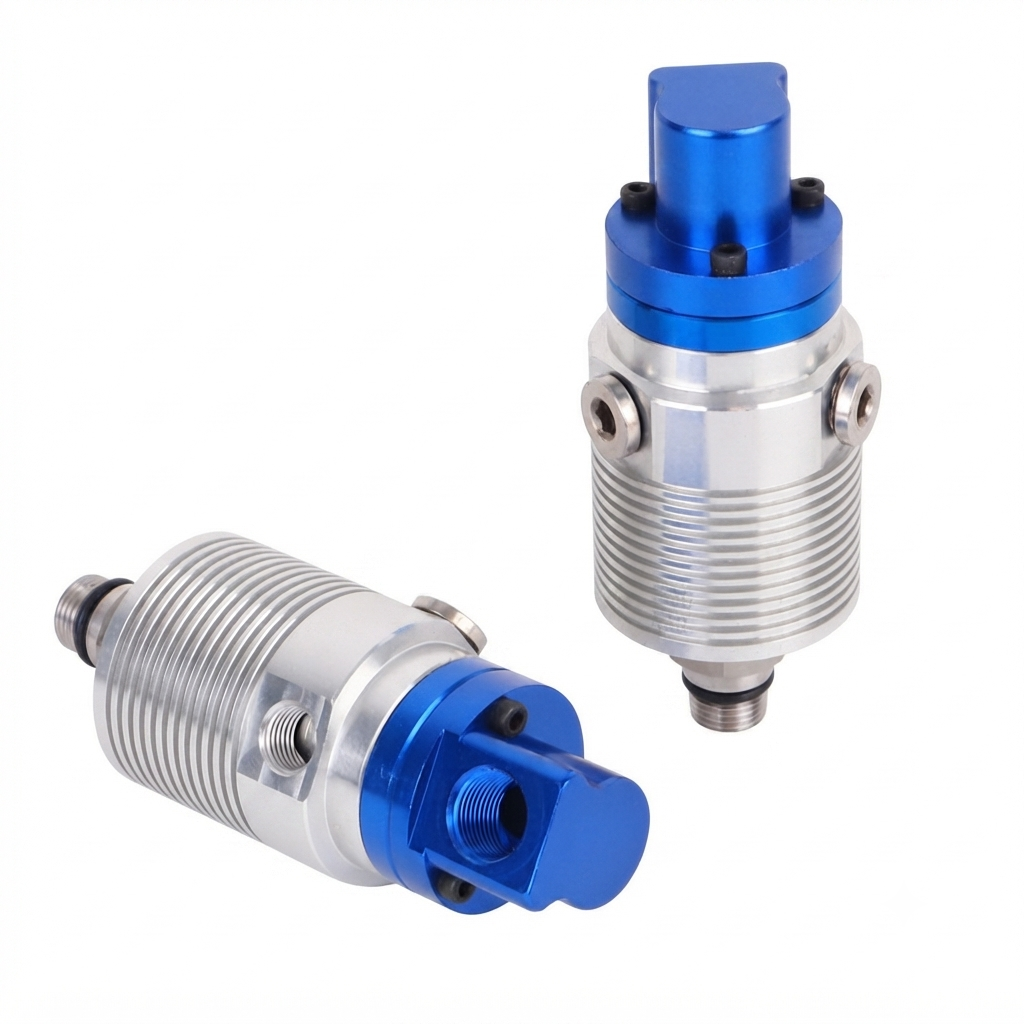
The RTH series uses an innovative external multi-spring balanced seal design that improves on conventional balanced seals in three ways:
1. External Spring Design
Traditional balanced seals use internal springs that are exposed to the media. Over time, scaling and corrosion degrade the springs, reducing sealing force.
The RTH series places the springs externally, away from the media path. This means:
- Springs remain clean and corrosion-free
- Sealing force stays consistent over the joint’s life
- Spring replacement is simpler when needed
2. Multi-Spring Configuration
Instead of a single spring or a coil spring, the RTH uses multiple small springs arranged around the seal circumference. This provides:
- More uniform pressure distribution
- Better compensation for minor misalignment
- Reduced risk of seal face tilting at high speeds
3. Balanced Geometry for Scaling Resistance
The balanced seal geometry in the RTH series is specifically designed to handle media that contains scale or particles. The reduced contact pressure means:
- Scale doesn’t embed into the seal face as easily
- Particles pass through rather than scratching the surfaces
- Self-cleaning effect during rotation
Performance Comparison
| Parameter | Unbalanced Seal | Balanced Seal (RTH) |
|---|---|---|
| Max pressure | 1.0 MPa | 1.6 MPa |
| Max speed | 1,000 rpm | 3,000 rpm |
| Seal life (water) | 1–2 years | 3–5 years |
| Leakage rate | Higher | Lower |
| Maintenance frequency | Every 6–12 months | Every 2–4 years |
| Tolerance to scale | Poor | Good |
| Cost | Lower initial | Lower lifetime |
When to Choose Balanced vs Unbalanced
Choose unbalanced when:
- Operating pressure is below 0.5 MPa
- Speed is below 500 rpm
- Budget is the primary concern
- Application is non-critical (temporary equipment, testing rigs)
Choose balanced when:
- Operating pressure exceeds 0.5 MPa
- Speed exceeds 1,000 rpm
- Media contains scale or particles
- Long service life is required
- Downtime is costly (continuous production lines)
- Temperature exceeds 100°C
The Lifetime Cost Perspective
A balanced seal joint typically costs 20–30% more than an unbalanced equivalent. But over a 5-year period:
- Unbalanced: 2–3 seal replacements × seal cost + 2–3 × downtime cost + labor
- Balanced: 0–1 seal replacement × seal cost + minimal downtime + lower labor
For a typical industrial application, the balanced seal pays for itself within 12–18 months through reduced maintenance and downtime.
Real-World Results
A steel mill in India replaced their conventional unbalanced joints on a continuous caster with RTH balanced seal joints. Results after 3 years:
- Seal replacements: Reduced from 4 per year to 0
- unplanned downtime: Reduced by 90%
- Annual maintenance cost: Reduced by $12,000 per joint position
Conclusion
For any application above 0.5 MPa or 1,000 rpm, a balanced seal design is the clear choice. The RTH series patented external multi-spring design combines the advantages of balanced sealing with enhanced durability and easier maintenance.
Need help selecting the right seal design for your application? Contact our engineering team for a free consultation.
Send Us Your Drawing or Duty Conditions
Tell us the medium, temperature, pressure, speed and connection size. Our engineers reply with a selection or a custom proposal — usually within one working day.