

High-Speed Rotary Joints: Engineering Challenges Above 10,000 RPM
The Speed Barrier
Most rotary joints operate comfortably below 3,000 RPM. But modern CNC machining centers, grinding spindles, and high-speed manufacturing equipment demand speeds of 10,000 RPM and beyond.
At these speeds, every engineering detail matters. The seal faces, bearings, balancing, and housing design must all work together to prevent failure.
Challenge 1: Centrifugal Force and Balancing
At 10,000 RPM, a 100g imbalance creates over 1,000N of centrifugal force. This force:
- Causes vibration that damages seal faces
- Creates uneven bearing loads
- Generates heat at the seal interface
- Can lead to catastrophic failure at extreme speeds
Solution: Precision dynamic balancing of all rotating components. The RT-DE CNC series is balanced to G6.3 or better per ISO 1940, ensuring smooth operation at speeds up to 10,000 RPM.
Challenge 2: Heat Generation at the Seal
Friction between the seal faces generates heat. At higher speeds, heat generation increases proportionally:
| Speed | Relative Heat Generation |
|---|---|
| 1,000 rpm | 1× (baseline) |
| 3,000 rpm | 3× |
| 5,000 rpm | 5× |
| 10,000 rpm | 10× |
Without proper cooling, seal face temperatures can exceed 200°C within minutes, causing thermal cracking and failure.
Solution: The RT-DE series uses a through-spindle coolant design where the cooling medium itself carries heat away from the seal interface. This dual-purpose design provides both process cooling and seal cooling simultaneously.
Challenge 3: Seal Face Flatness
At high speeds, even minor seal face imperfections cause:
- Localized high spots that generate excessive heat
- Uneven wear patterns
- Leakage paths that develop over time
Specification: High-speed seal faces must be lapped to within 2 light bands (approximately 0.6μm) flatness across the entire sealing surface.
Solution: The RT-DE series uses precision-lapped silicon carbide or ceramic seal faces, manufactured to optical flatness standards.
Challenge 4: Bearing Design
Standard ball bearings have speed limitations defined by their DN value (bore diameter × speed in RPM):
| Bearing Type | Typical DN Limit | Max Speed (25mm bore) |
|---|---|---|
| Deep groove ball | 1,000,000 | 40,000 rpm |
| Angular contact | 1,200,000 | 48,000 rpm |
| Ceramic hybrid | 2,000,000+ | 80,000+ rpm |
For rotary joints, the bearing must also handle the pressure load from the media, not just rotational forces.
Solution: The RT-DE series uses precision angular contact bearings with ceramic balls for the highest speed applications, providing both speed capability and load capacity.
Challenge 5: Vibration and Noise
High-speed rotation amplifies any imbalance or misalignment into vibration and noise. This:
- Accelerates wear on all components
- Creates operator discomfort
- Can trigger machine tool alarms
- Indicates impending failure
Acceptable vibration levels:
- Below 3,000 rpm: <1.0 mm/s velocity
- 3,000–10,000 rpm: <0.5 mm/s velocity
- Above 10,000 rpm: <0.3 mm/s velocity
Solution: Dynamic balancing + precision bearings + proper installation = vibration levels within specification.
How the RT-DE CNC Series Addresses These Challenges
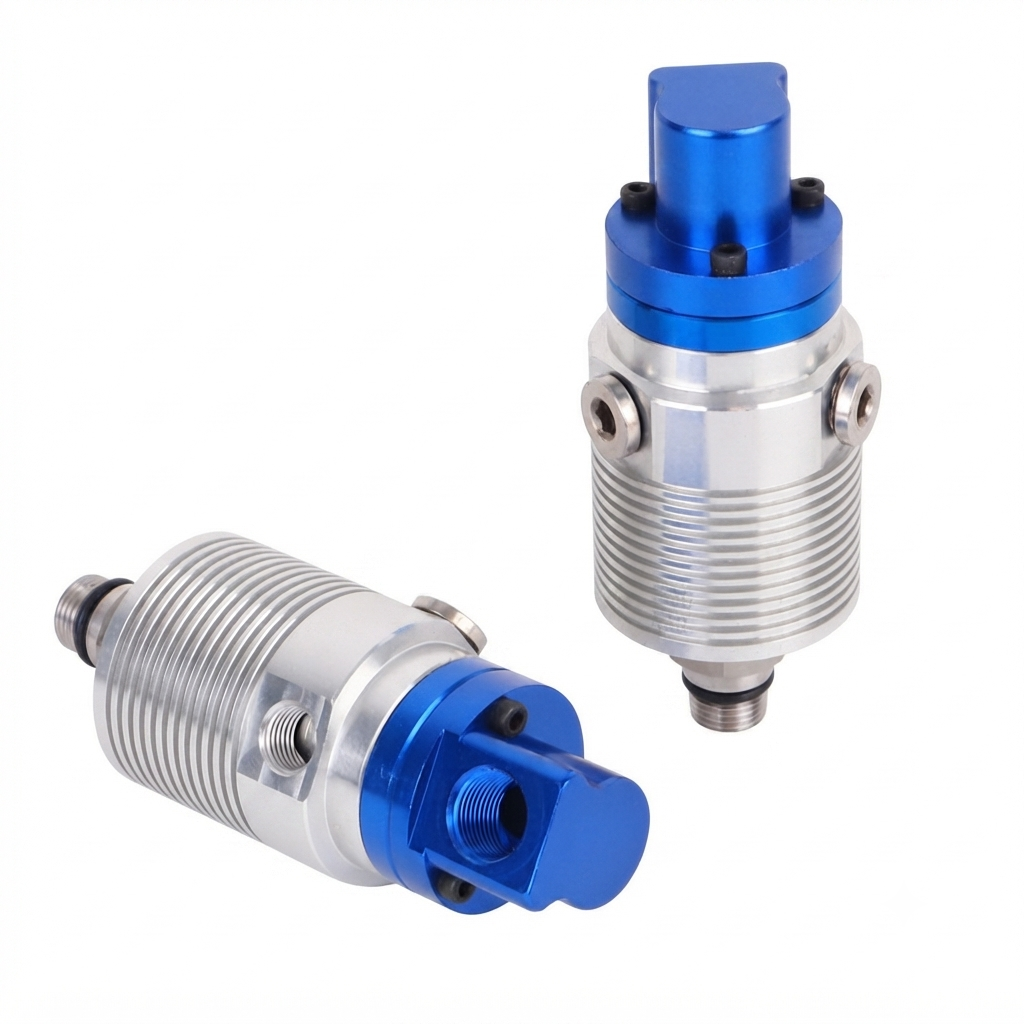
The RT-DE series was specifically engineered for high-speed CNC machining centers:
Design Features
- Through-spindle coolant path — Coolant flows through the center of the joint, providing both process cooling and seal cooling
- Precision-balanced rotating assembly — Dynamic balancing to G6.3 or better
- Ceramic seal faces — Silicon carbide or ceramic for maximum hardness and thermal stability
- Angular contact bearings — High-speed rated with ceramic ball option
- Forged brass housing — Excellent thermal conductivity for heat dissipation
- Compact design — Minimal overhang to reduce moment loads
Performance Specifications
| Parameter | RT-DE Specification |
|---|---|
| Maximum speed | 10,000 RPM |
| Maximum pressure | 1.0 MPa |
| Coolant compatibility | Water, oil, MQL |
| Seal material | Silicon carbide / Ceramic |
| Bearing type | Angular contact (ceramic option) |
| Housing material | Forged brass |
| Connection | Threaded (G/NPT) |
Typical Applications
- CNC machining center spindle cooling
- High-speed grinding spindle coolant
- Woodworking spindle cooling
- Semiconductor manufacturing equipment
- High-speed testing equipment
Installation Requirements for High-Speed Joints
High-speed joints demand more precise installation than standard joints:
- Shaft runout: Must be less than 0.02mm TIR (total indicator reading)
- Shaft surface finish: Ra 0.4–0.8μm for seal face contact
- Coolant supply: Clean, filtered, temperature-controlled
- Piping: Flexible connections to absorb vibration
- Alignment: Within 0.1mm offset and 0.05mm/100mm angular
Maintenance at High Speed
High-speed joints require more frequent monitoring:
- Daily: Visual check for leaks, listen for noise changes
- Weekly: Check coolant flow rate and temperature
- Monthly: Measure vibration levels
- Per 500 hours: Inspect seal faces (may need replacement every 1,000–2,000 hours at maximum speed)
When to Consider High-Speed Upgrades
If your current joint is:
- Operating near its speed limit consistently
- Showing signs of seal wear at shorter-than-expected intervals
- Generating excessive vibration or noise
- Causing unplanned downtime
…it may be time to upgrade to a purpose-built high-speed joint.
Getting the Right High-Speed Solution
High-speed applications require careful engineering. The wrong joint choice at 10,000 RPM doesn’t just fail — it fails dangerously.
Ruitus engineers can help you select the right high-speed joint based on your exact speed, pressure, coolant, and mounting requirements.
Contact our engineering team to discuss your high-speed application.
Send Us Your Drawing or Duty Conditions
Tell us the medium, temperature, pressure, speed and connection size. Our engineers reply with a selection or a custom proposal — usually within one working day.