

Stainless Steel vs Brass Rotary Joints: Material Selection Guide
The Material Decision
The housing material of a rotary joint affects its corrosion resistance, strength, thermal conductivity, weight, and cost. The two most common materials are brass and stainless steel — each with distinct advantages and trade-offs.
This guide compares both across the factors that matter most in real-world applications.
Factor 1: Corrosion Resistance
Brass
- Good resistance to water, coolant, and most neutral media
- Poor resistance to ammonia, acids, and sulfur-containing media
- Susceptible to dezincification in certain water conditions (high chloride, low pH)
- Surface patina develops over time (green/brown) — cosmetic, not functional
Stainless Steel
- Excellent resistance to most media including water, steam, oil, and many chemicals
- Superior resistance to chloride environments (316L grade)
- Resistant to dezincification, stress corrosion cracking
- Maintains appearance over time
Winner for corrosion resistance: Stainless steel — especially 316L for aggressive environments.
Factor 2: Thermal Conductivity
Brass
- Thermal conductivity: ~120 W/m·K
- Excellent heat dissipation from seal faces
- Helps prevent thermal buildup at the seal interface
- Better for high-speed applications where heat generation is a concern
Stainless Steel
- Thermal conductivity: ~16 W/m·K (304) / ~14 W/m·K (316L)
- Lower heat dissipation — seal faces may run hotter
- May require additional cooling measures at high speeds
Winner for thermal conductivity: Brass — by a significant margin. This is why the RT-DE CNC series uses forged brass housing.
Factor 3: Mechanical Strength
Brass
- Tensile strength: 350–500 MPa (depending on alloy)
- Adequate for most rotary joint applications
- Forged brass (used in RT-DE) is stronger than cast brass
- Good fatigue resistance
Stainless Steel
- Tensile strength: 500–700 MPa (304) / 485–620 MPa (316L)
- Higher strength for high-pressure applications
- Better resistance to impact and shock loads
- Required for pressures above 10 MPa in many designs
Winner for strength: Stainless steel — necessary for high-pressure hydraulic applications.
Factor 4: Weight
Brass
- Density: 8.5 g/cm³
- Heavier than stainless steel
- May affect mounting and support requirements for large joints
Stainless Steel
- Density: 7.9 g/cm³ (304) / 8.0 g/cm³ (316L)
- Slightly lighter than brass
- Minimal difference for most rotary joint sizes
Winner for weight: Stainless steel — marginally lighter.
Factor 5: Machinability
Brass
- Excellent machinability — easy to turn, mill, and drill
- Faster production = lower manufacturing cost
- Better surface finish achievable
- Easier to modify or customize
Stainless Steel
- Good machinability — but requires sharper tools and slower speeds
- Higher manufacturing cost
- Work hardening can be an issue
- More difficult to achieve fine surface finishes
Winner for machinability: Brass — significantly easier and cheaper to machine.
Factor 6: Cost
Brass
- Material cost: Moderate (copper-zinc alloy)
- Manufacturing cost: Lower (easier to machine)
- Total cost: Lower for most standard applications
Stainless Steel
- Material cost: Higher (especially 316L)
- Manufacturing cost: Higher (harder to machine)
- Total cost: Higher, but justified for corrosive or high-pressure applications
Winner for cost: Brass — typically 20–40% less expensive than stainless steel equivalents.
Factor 7: Food and Pharmaceutical Applications
Brass
- Not suitable for food or pharmaceutical contact
- Copper ions can leach into media
- Does not meet FDA or food-grade requirements
Stainless Steel
- Required for food and pharmaceutical applications
- 316L grade meets FDA and EU food contact regulations
- Easy to clean and sanitize
- Non-reactive with food products
Winner for food/pharma: Stainless steel — the only acceptable choice.
Factor 8: High-Temperature Performance
Brass
- Maximum continuous temperature: ~200°C
- Softens at higher temperatures
- Thermal expansion is higher than stainless steel
- Good for moderate-temperature applications
Stainless Steel
- Maximum continuous temperature: ~400°C (304) / ~450°C (316L)
- Maintains strength at higher temperatures
- Lower thermal expansion
- Required for high-temperature steam and thermal oil applications
Winner for temperature: Stainless steel — necessary above 200°C.
Decision Matrix
| Factor | Brass | Stainless Steel | Winner |
|---|---|---|---|
| Corrosion resistance | Good | Excellent | Stainless |
| Thermal conductivity | Excellent | Poor | Brass |
| Mechanical strength | Good | Excellent | Stainless |
| Weight | Heavier | Lighter | Stainless |
| Machinability | Excellent | Good | Brass |
| Cost | Lower | Higher | Brass |
| Food/pharma | Not suitable | Required | Stainless |
| High temperature | Up to 200°C | Up to 450°C | Stainless |
Application-Based Recommendations
Choose Brass When:
- Media is water, coolant, or neutral oil
- Operating temperature is below 200°C
- Pressure is below 10 MPa
- No corrosive media present
- Cost is a primary concern
- High-speed application (better heat dissipation)
Typical applications: CNC machining, general industrial, machine tool cooling
Choose Stainless Steel When:
- Media is corrosive (saltwater, chemicals, acids)
- Operating temperature exceeds 200°C
- Pressure exceeds 10 MPa
- Food or pharmaceutical application
- Hygienic environment required
- Marine or offshore application
Typical applications: Chemical processing, food processing, marine, pharmaceutical, high-pressure hydraulics
Ruitus Material Options
Ruitus offers both brass and stainless steel rotary joints:
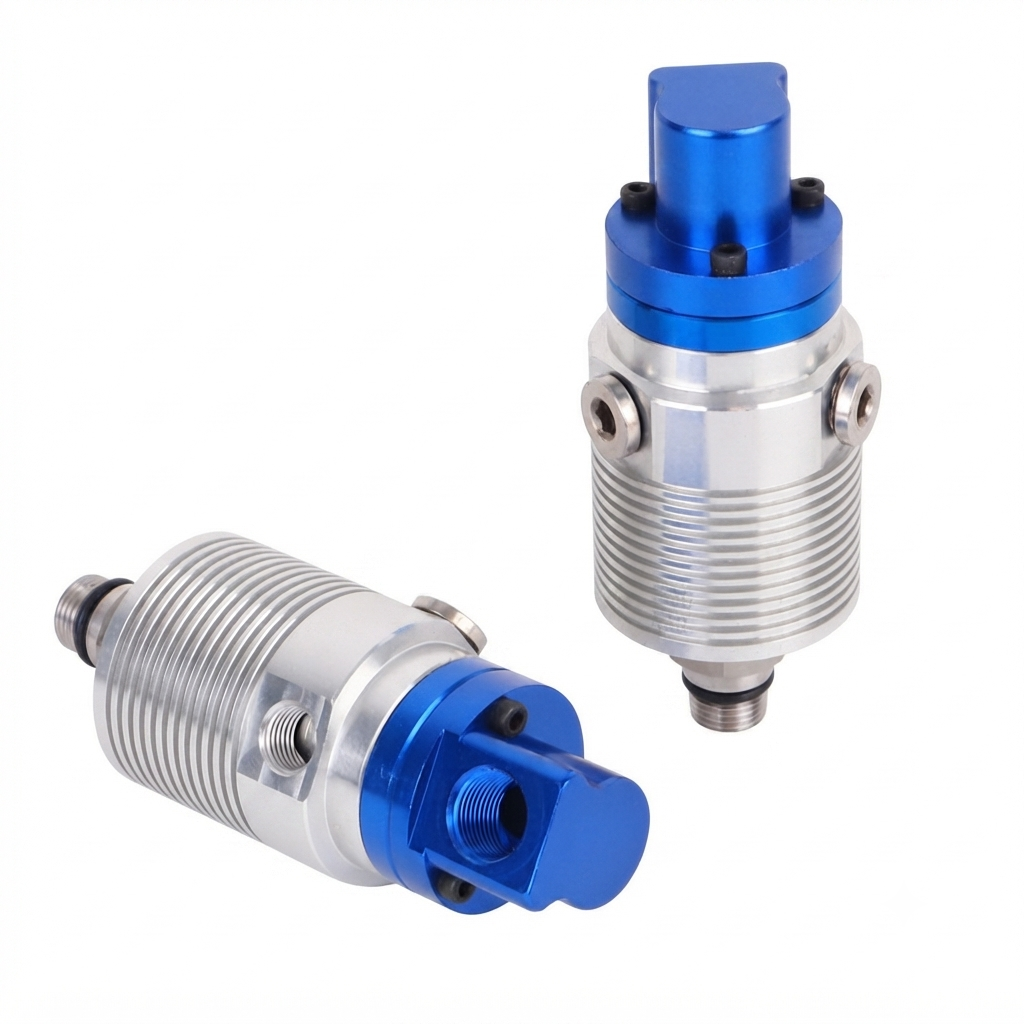
- RT-DE CNC series: Forged brass housing — optimized for high-speed CNC applications with excellent heat dissipation
- JL-DD/JL-DC series: Precision-cast stainless steel — for corrosive environments, food processing, and high-temperature applications
- RTH series: Brass or stainless steel options — for general industrial applications
- RT-GY series: Steel construction — for high-pressure hydraulic applications
Need Help Choosing?
The right material depends on your specific application conditions. Share your media type, temperature, pressure, and environment with our engineering team, and we’ll recommend the optimal material selection.
Contact us for a material recommendation tailored to your application.
Send Us Your Drawing or Duty Conditions
Tell us the medium, temperature, pressure, speed and connection size. Our engineers reply with a selection or a custom proposal — usually within one working day.