

CNC Through-Spindle Coolant Joints: Complete Buyer's Guide
Why Through-Spindle Coolant Matters
Traditional flood coolant sprayed from outside the tool often fails to reach the cutting zone — especially in deep hole drilling, pocket milling, and high-speed machining. Through-spindle coolant (TSC) delivers coolant directly through the tool, providing:
- Better chip evacuation — Coolant pressure pushes chips out of the cutting zone
- Lower tool temperature — Direct cooling at the cutting edge
- Longer tool life — 30–50% improvement is common
- Faster cycle times — Higher feed rates possible with reliable cooling
- Better surface finish — Consistent cooling prevents thermal damage
The rotary joint is the critical component that makes TSC possible — it connects the stationary coolant supply to the rotating spindle.
How Through-Spindle Coolant Joints Work
The joint sits between the machine’s coolant supply and the spindle. As the spindle rotates, the joint allows coolant to flow through its center bore into the spindle and out through the tool.
Key components:
- Seal assembly — Prevents coolant leakage at the spindle interface
- Bearing system — Supports rotation at spindle speed
- Coolant path — Central bore through the joint body
- Connection ports — Inlet (from machine) and outlet (to spindle)
Critical Selection Factors
1. Spindle Speed
This is the most important specification. The joint must handle your spindle’s maximum RPM.
| Spindle Speed | Joint Category | Typical Application |
|---|---|---|
| Up to 3,000 rpm | Standard | General machining |
| 3,000–6,000 rpm | Medium speed | High-speed machining |
| 6,000–10,000 rpm | High speed | Precision machining |
| Above 10,000 rpm | Ultra-high speed | Aerospace, semiconductor |
Never underspecify speed. A joint rated for 5,000 RPM running at 8,000 RPM will fail prematurely — and potentially dangerously.
2. Coolant Pressure
Different operations require different pressures:
- Low pressure (up to 1 MPa): Basic chip evacuation, tool cooling
- Medium pressure (1–3 MPa): Deep hole drilling, pocket milling
- High pressure (3–7 MPa): Gun drilling, high-speed machining
- Ultra-high pressure (7+ MPa): Specialized applications
Note: Higher pressure requires stronger seals and more robust housing. The joint’s pressure rating must exceed your system’s maximum pressure, including pressure spikes.
3. Coolant Type
The coolant affects seal material selection:
- Water-soluble coolant (emulsion): Standard carbon or ceramic seals
- Straight oil: Requires oil-compatible seal materials
- MQL (Minimum Quantity Lubrication): Specialized seals for oil-air mixture
- Synthetic coolant: Check chemical compatibility with seal materials
4. Spindle Taper Size
The joint must physically fit your spindle. Common taper sizes:
- BT/BT30: Smaller machines, lower flow requirements
- BT/BT40: Most common, medium flow
- BT/BT50: Heavy-duty machines, high flow
- HSK: High-speed machines, precision applications
5. Flow Rate Requirements
Flow rate depends on your machining operations:
- Light machining: 5–15 L/min
- Medium machining: 15–30 L/min
- Heavy machining: 30–60 L/min
- High-pressure drilling: 60+ L/min
The joint’s internal bore diameter determines maximum flow rate. Larger bore = higher flow = better cooling.
RT-DE CNC Series: Designed for Modern Machining
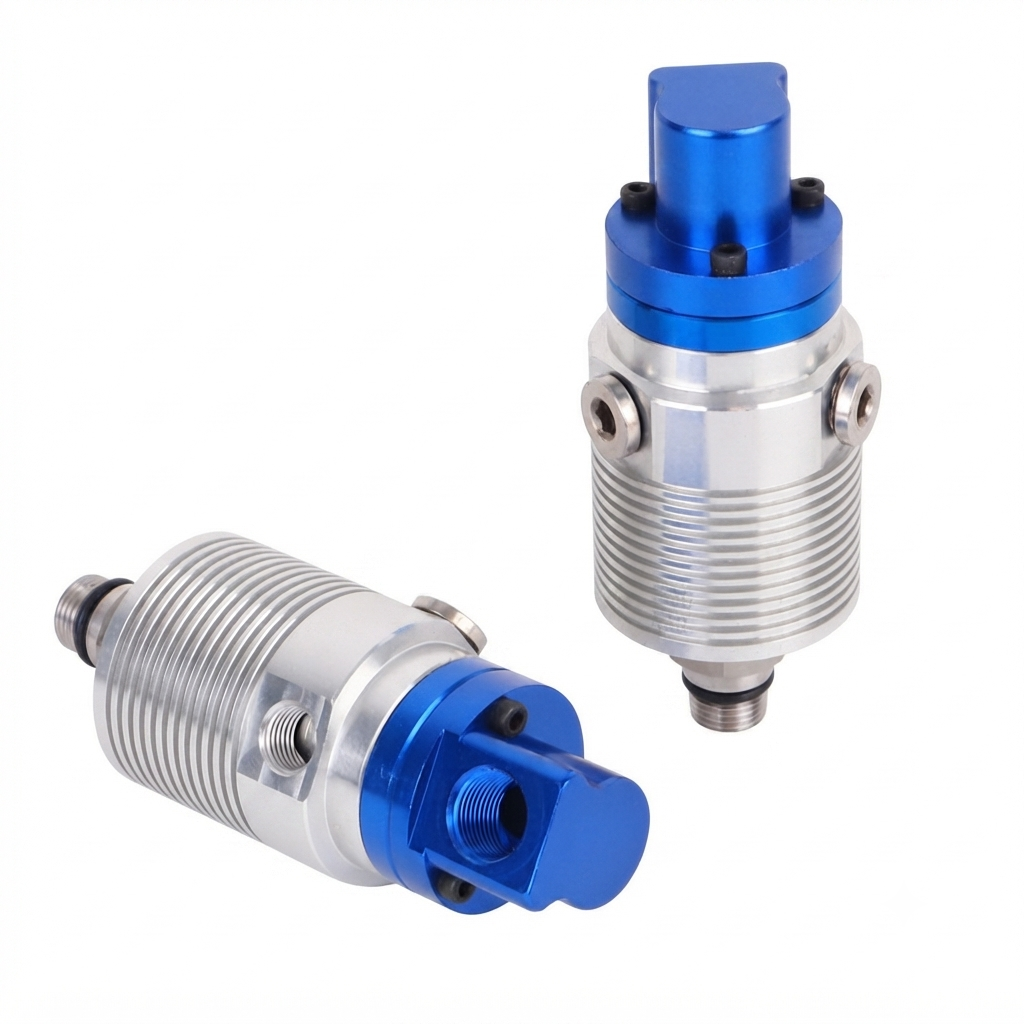
The Ruitus RT-DE CNC through-spindle coolant joint is specifically engineered for the demands of modern CNC machining centers:
Key Features
- Speed rating: Up to 10,000 RPM
- Pressure rating: Up to 1.0 MPa (10 bar)
- Coolant compatibility: Water, oil, MQL
- Forged brass housing: Excellent thermal conductivity
- Precision-balanced: Dynamic balancing to G6.3
- Ceramic seal faces: Maximum hardness and thermal stability
- Compact design: Minimal impact on spindle overhang
Compatibility
The RT-DE series is designed as a direct replacement for imported 55-57 series joints, making it compatible with:
- Most CNC machining centers (Fanuc, Mitsubishi, Siemens controls)
- Vertical and horizontal mills
- Turning centers with live tooling
- Grinding machines
Installation
Installation is straightforward for qualified technicians:
- Remove the existing joint (if replacing)
- Clean the spindle taper and mounting surface
- Install the new joint with proper alignment
- Connect coolant supply lines
- Test at low pressure and speed before full operation
Common Mistakes to Avoid
- Underspecifying speed: Always use your spindle’s maximum RPM, not average
- Ignoring pressure spikes: Account for pump startup spikes in your pressure rating
- Wrong coolant type: Verify seal compatibility before installation
- Poor coolant quality: Particles in coolant damage seals. Use proper filtration.
- Skipping alignment: Misalignment causes premature seal wear
- Delayed maintenance: Seal replacement is cheaper than spindle repair
Maintenance Schedule
| Task | Frequency | Notes |
|---|---|---|
| Visual leak check | Daily | During operation |
| Coolant flow check | Weekly | Compare to specification |
| Vibration check | Monthly | Use vibration meter |
| Seal inspection | Per 1,000 hours | Replace if worn |
| Full joint overhaul | Per 3,000 hours | Replace seals + bearings |
ROI of Through-Spindle Coolant
Investing in a quality TSC joint pays for itself through:
- Tool life improvement: 30–50% longer tool life
- Cycle time reduction: 15–25% faster machining
- Scrap reduction: Better cooling = fewer rejected parts
- Unplanned downtime reduction: Quality joints run longer
For a typical CNC machining center running 2,000 hours/year, the combined savings often exceed $5,000 annually — more than 10× the cost of the joint.
Getting the Right Recommendation
Selecting the right through-spindle coolant joint requires matching the joint to your specific machine, spindle, and machining operations.
Ruitus engineers can help you select the correct model based on your spindle speed, coolant pressure, flow requirements, and machine configuration.
Contact us with your machine specifications for a personalized recommendation.
Send Us Your Drawing or Duty Conditions
Tell us the medium, temperature, pressure, speed and connection size. Our engineers reply with a selection or a custom proposal — usually within one working day.